Why Study in Malaysia in 2027? Quality Degrees, Smart Budgets and a Global Future

Taksheela Team
Taksheela Institute of Education
Imagine how your international education would feel with campuses which are up to date, classes taught in English, an array of cultures, and even a budget which seems more realistic. This is what Malaysia provides for Indians. From skyscrapers in Kuala Lumpur to buzzing university towns, this country takes the experience of overseas education right to your doorstep.
However, selecting a destination goes beyond mere aesthetics. You require dependable statistics on UG and PG tuition fees, a realistic cost of living, the visa process, and an accurate representation of job prospects. Here is what you should know before making a decision to pursue your studies in Malaysia in 2027.
1. Why Malaysia Is Becoming a Smart Study-Abroad Choice
Malaysia has both state-owned universities, private universities, and international campuses. This provides an opportunity for learners to assess their locally awarded qualifications and also the UK or Australian qualifications. The English language is extensively spoken among university students in Malaysia, but there are particular programs that demand evidence of proficiency in English.
Multicultural environment is yet another strength since Indian students will come across various food cultures, religions and even international student associations. However, always remember to select your educational institute based on programme accreditation, teaching standard, infrastructure and outcome.
2. Undergraduate and Postgraduate Tuition Fees: What Should You Budget?
There is a vast difference in tuition fees based on subjects and educational institutions. According to Education Malaysia, some selected foreign branch campus degrees might cost about RM20,000-RM50,000 per year. This is just an example of one of the categories of fees, but not all.
In the case of universities that are government-owned, the Universiti Teknologi Malaysia provides an illustration with tuition costs for international undergraduate students of roughly RM63,000 for certain areas of science and design, RM71,000 for computing, and RM75,000 for engineering.
Postgraduate tuition fees differ from programme to programme. The fee schedule provided by Universiti Malaya for the academic year 2025/26 has been listed below: Master of Science in Statistics at RM27,000, Master of Data Science at RM41,700, and MBA at RM79,100. However, the above are only programme-specific fees and cannot be generalised to other universities.
Recall the extra 6% tax that was imposed on international students' tuition since July 2025. Check whether it is covered in the package that you were offered, along with registration and lab/examination fees. You should never compare annual fees with degree fees.
3. What Is the Cost of Living in Malaysia?
Malaysia can be affordable, though monthly costs will depend on your location and lifestyle. According to the Education Malaysia MYCAS guidelines, an average amount of RM1,100 is given as a base figure. Similarly, their guideline on cost of living indicates that living expenses can increase depending on the type of housing and lifestyle.
Rooms and dormitories could lower your expenses. Cost of living in Kuala Lumpur could be higher than other university towns. Make sure that utilities, electricity, internet, AC, and security deposit are included in the rental fee. Using food courts, public transportation, and student discounts could keep your regular costs down.
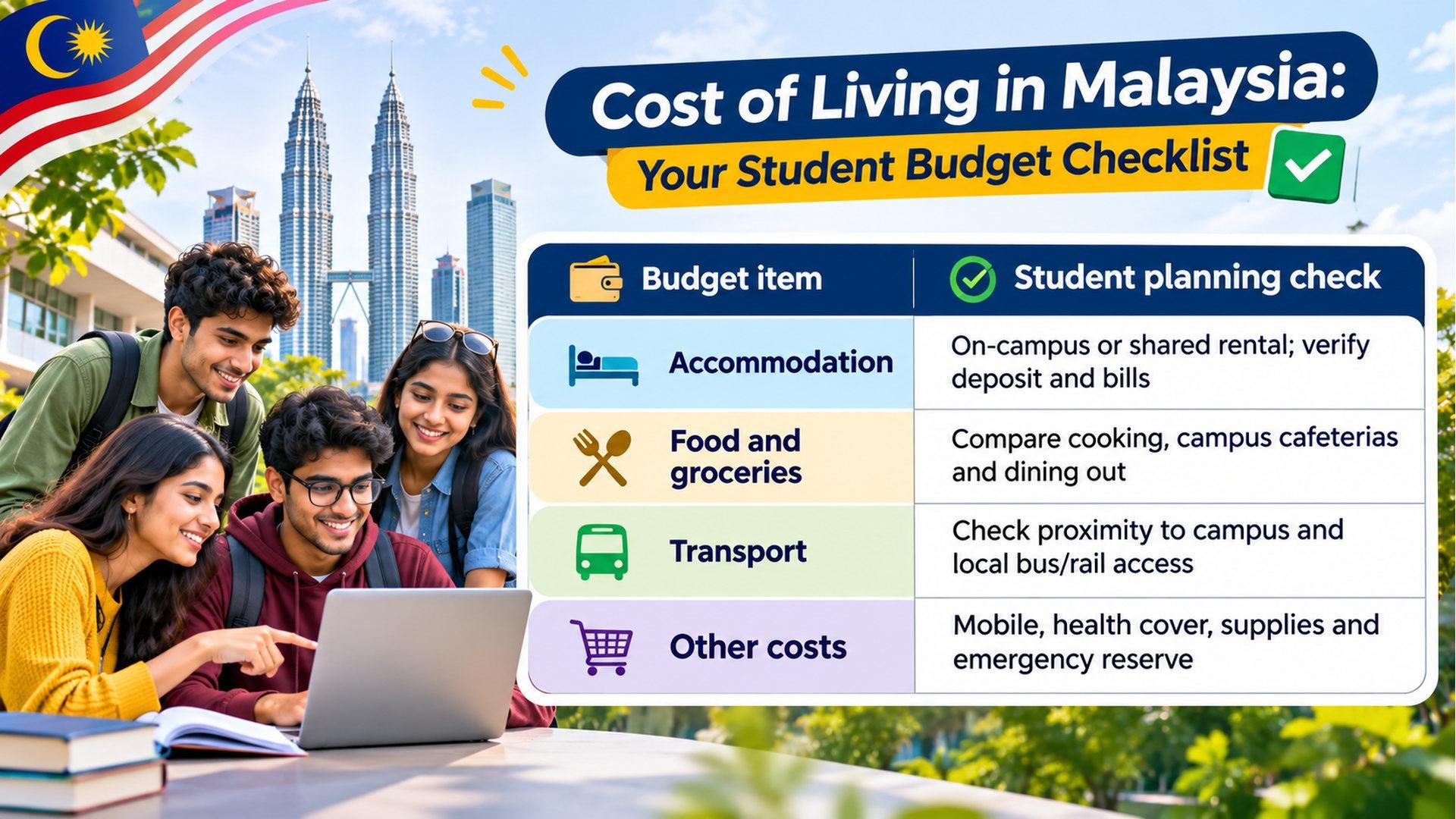
Plan for twelve months and not just for teaching periods. Travelling costs back home, health insurance, and repair costs may increase the total expense. Exchange ringgit to rupees according to the current exchange rate and not any old one.
4. Malaysia Student Visa Requirements: The Exact Sequence
Most international students must get an offer from a recognised university and obtain a Student Pass via Education Malaysia Global Services (EMGS), including a Malaysian Immigration. The applicant is supposed to be out of Malaysia when making an application for a higher education Student Pass.
The usual sequences are:
Receive your offer
Gather your passport, academic qualifications, photo, medical form, and required proof of English language proficiency
Submit your application via an authorised institution or EMGS route;
Obtain the electronic Visa Approval Letter (eVAL);
Apply for a visa if your nationality necessitates it;
Travel;
Undertake your post-arrival medical screening within seven days;
Get your Student Pass endorsement from your institution.
EMGS recommends that the passports usually have a minimum validity of 18 months for a fresh application, and longer validity is advised depending on the length of the course. The supporting documents needed, visa fees, insurance, iKad fees, and personal bond fees will differ. Use the EMGS fee calculator rather than relying on an estimated agent's quote.
5. Can International Students Work During Their Studies?
Part-time jobs cannot be undertaken arbitrarily; rather, part-time working is conditional upon being permitted to do so. This does not happen automatically for the whole duration of the term. According to the guidelines by Education Malaysia, eligible international students enrolled in authorised higher-education establishments can work up to 20 hours per week during vacation periods that last more than a week, but with immigration and sectoral approval.
Additionally, Malaysia offers a Graduate Pass to qualified graduates, although certain criteria must be met. Please note that before considering the Graduate Pass as an employment visa, you should first determine your qualifications and check other requirements such as nationality, insurance, and working permits.
6. Which Courses and Universities Should You Explore?
Areas of interest could include business, information technology, engineering, hospitality, health sciences, and creative arts. Public universities should be compared to accredited private universities and branch campuses internationally. Don't just look at promotions; make sure the college is recognised by the Malaysian Qualifications Agency, has professional licensing if necessary, does internships, teaches language, and covers all years of study.
For Indian students, professional licensing and registration requirements in one’s own country may be just as important as an institution’s international reputation. This is a particularly important consideration for students interested in medical studies or law and other professions.
7. Scholarships, Admissions and Hidden Expenses
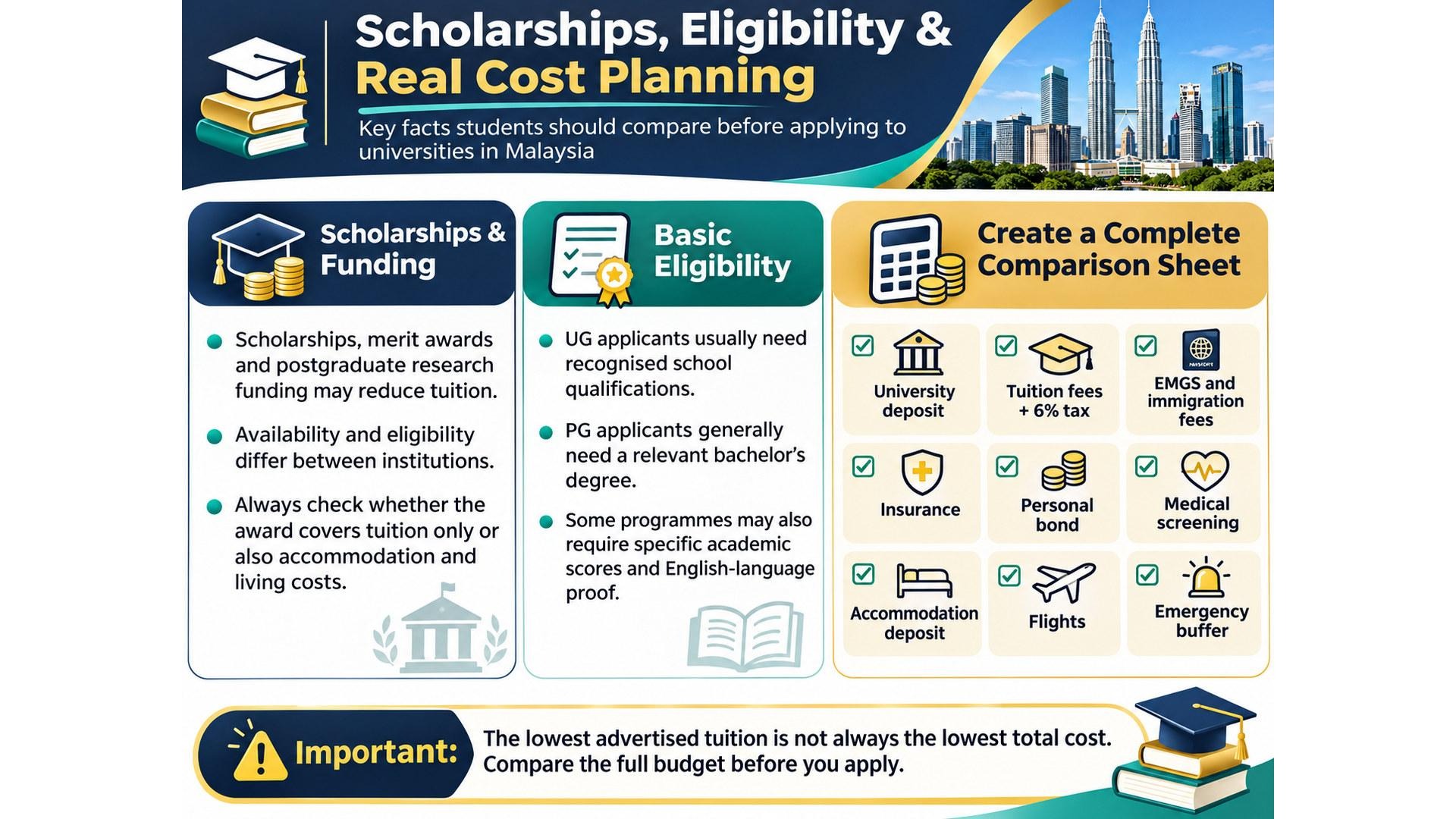
While scholarships, merit awards, and postgraduate research grants can help pay for your tuition, the amount and criteria vary from institution to institution. It is important that you check whether the scholarship will cover just tuition or housing and living expenses as well. For undergraduate applications, one needs to have recognised qualifications from a secondary school; for graduate applications, a related bachelor’s degree is required and other programme-related criteria could apply.
Create a complete comparison sheet before applying: university deposit, tuition and tax, EMGS and immigration fees, insurance, personal bond, medical screening, accommodation deposit, flights and an emergency buffer. The lowest advertised tuition is not always the lowest total cost.
8. How Can Taksheela Help You Make the Right Choice?
Taksheela Institute of Education will assist you in making comparisons between universities in Malaysia, selecting the most appropriate undergraduate and postgraduate courses for you, knowing their admission criteria, and preparing a detailed budget and application documents. The aim is to select a course which fits you best from an academic point of view and not only from a cost aspect.
Frequently Asked Questions
Usually, yes, especially for students who will be comparing tuition and room-and-board costs. Calculate the total cost of the course.
No, not always. The English language qualification criteria depend on the programme and EMGS policies.
Only according to your existing eligibility criteria for working, which have limitations as far as timing and sectors are concerned.
Start several months before the intake to allow time for admissions, eVAL approval, travel and medical formalities.
Free MBBS Counselling
Find the Right Country for Your MBBS in 2026
Our MBBS specialists analyse your NEET score, budget and career goals to recommend the right university — at zero cost to you.
Related Articles

Study in Nordic Countries 2027: Costs, Quality Education and Career Paths for Indian Students
20 Nov 2026 · 11 min

Study in Malta 2027 for Indian Students: Tuition Fees, Visa and Work Rules
13 Nov 2026 · 10 min

Australia vs New Zealand: Which Destination Gives Students More Value in 2027?
11 Nov 2026 · 12 min
Planning your study abroad journey?
Get free expert counselling from Taksheela — trusted by thousands of Indian students for admissions, visas, and test prep.
You May Also Like
More Study Abroad & Education Guides




Study in Nordic Countries 2027: Costs, Quality Education and Career Paths for Indian Students
20 Nov 2026 · 11 min
Study in Malta 2027 for Indian Students: Tuition Fees, Visa and Work Rules
13 Nov 2026 · 10 min
Australia vs New Zealand: Which Destination Gives Students More Value in 2027?
11 Nov 2026 · 12 min
Study Abroad Budget Planning 2027: Tuition Fees, Living Costs and Other Expenses
22 Oct 2026 · 16 min