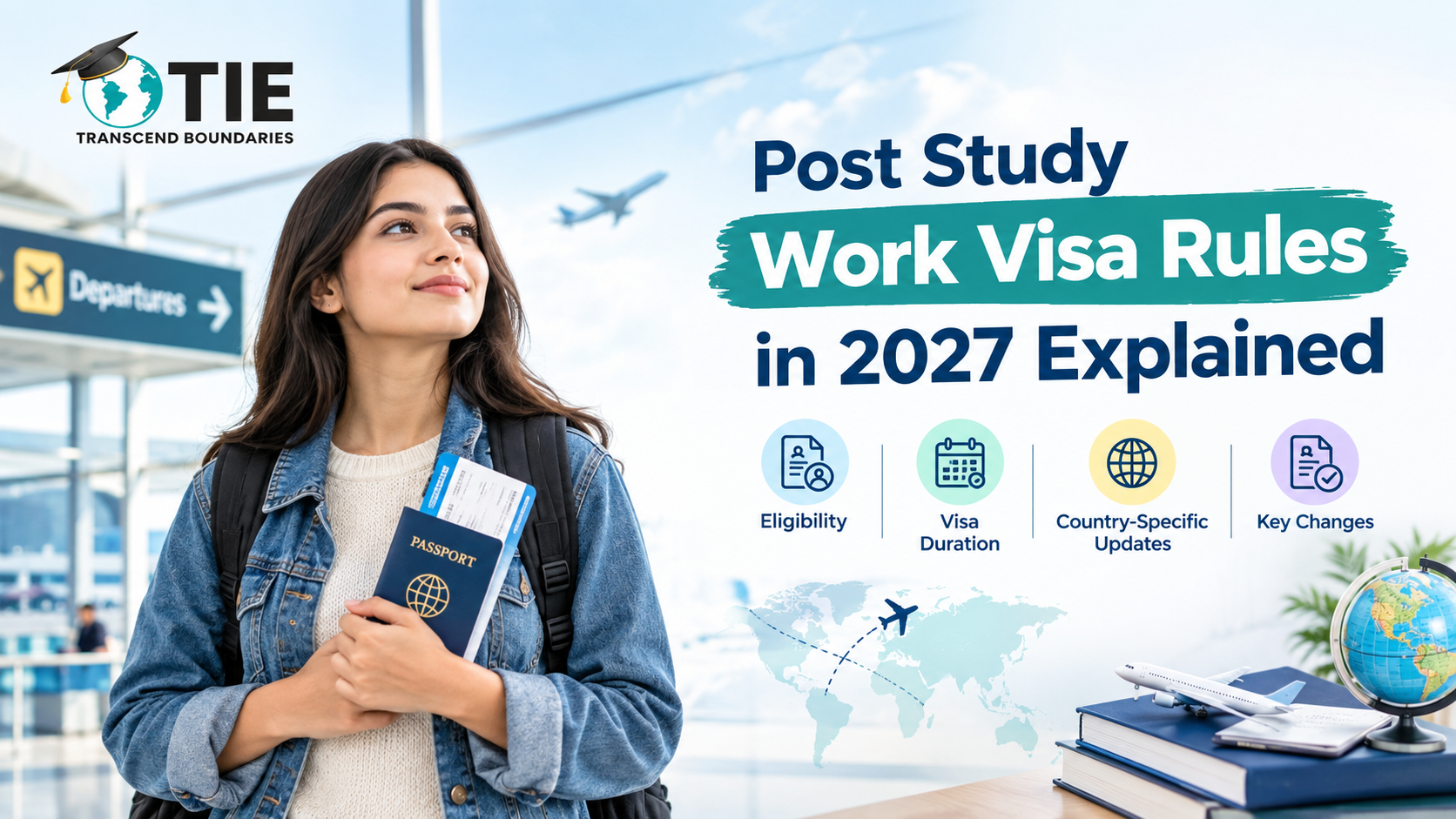
Post Study Work Visa Rules in 2027 Explained
Taksheela Team
Taksheela Institute of Education
A three-year degree can take you years to plan. Your options after that degree can depend on immigration rules that change much faster. This is why students planning overseas education should look at post-study work provisions before finalising a destination.
The rules can differ by country, qualification, and graduate status, and some major changes are already set for 2027. Here's what students should know before making that decision.
What Does “Post-Study Work” Really Mean?
Post-study work refers to the immigration route that allows eligible international graduates to remain in a country after completing their studies to work or, in some destinations, look for employment.
It does not look the same everywhere.
For example, the UK uses the Graduate visa, Canada uses the Post-Graduation Work Permit (PGWP), Australia uses the Temporary Graduate visa, and New Zealand has a Post Study Work Visa. In the USA, graduates usually look at Optional Practical Training (OPT), with eligible STEM graduates potentially qualifying for an additional 24-month extension.
So, when students search for a post study work visa, they should first check what the relevant route is actually called in their chosen country.
Why Should You Check Post-Study Rules Before Choosing Your University?
Choosing a university only on the basis of rankings, fees, or location can leave out an important part of the decision.
Your post-study options may affect:
How long you can remain after graduation
Whether you can work freely or have conditions attached
What qualifications are eligible
Whether your field of study affects eligibility
What options you have after the graduate route ends
Whether the country fits your long-term career goals
These rules can also change during the years between admission and graduation. That is why students should check the rules that apply to their expected graduation period rather than relying on information from several years ago.
How Long Can You Stay After Graduation in Different Countries?
The duration varies significantly between study destinations, and the maximum period does not automatically apply to every graduate.
These are current or confirmed framework durations, not a guarantee that every student will receive the maximum period. For example, Canada's PGWP duration depends on the level and length of the study program, while Australia's Temporary Graduate visa generally provides two to three years depending on qualification.
Germany currently allows eligible graduates to stay for up to 18 months to seek employment; on the other hand, the Netherlands' orientation-year permit is valid for one year.
New Zealand allows eligible graduates to stay and work for up to three years, depending on their qualification.
Which Factors Can Change Your Post-Study Work Eligibility?
Your eligibility can depend on:
Your degree level
Length of the program
Institution and program eligibility
Field of study
Immigration status
Date of application
Whether you completed the required period of study
Language or other eligibility requirements
Canada is a good example. PGWP eligibility depends on the type of institution and program, while some graduates must also meet language and field-of-study requirements.
A master's graduate can potentially qualify for a three-year PGWP even when the master's program itself was shorter than two years, provided the other requirements are met. Taksheela Institute of Education helps students understand these requirements while comparing their study and post-study options.
Does a Longer Stay-Back Period Mean Better Career Opportunities?
Not necessarily.
More time after graduation may give you more opportunity to look for relevant employment, gain experience and learn the local job market. But just because the visa is long does not mean it will be easy to find work.
Your outcome can also depend on:
Demand for your profession
Your skills and experience
Location
Salary expectations
Employer requirements
Industry conditions
Whether your qualification matches available roles
For example, New Zealand's official guidance notes that some qualifications allow graduates to work in any job, while certain lower-level qualifications require the job to be related to the field of study.
The better question isn't simply “Which country gives the longest stay?” It is “Which country gives me a realistic route from my degree to the career I want?”
Why Does the UK Change Matter to Students Starting in 2027?
The UK is particularly important for students planning around 2027 because its Graduate visa rules are changing.
Applications made on or before 31 December 2026 can receive a two-year Graduate visa. For the applications made on or after 1 January 2027, the period becomes 18 months for most eligible graduates. Doctoral graduates continue to receive three years.
The Graduate visa also cannot be extended. However, eligible graduates may be able to switch to another immigration route, such as the Skilled Worker visa.
For a student planning several years ahead, this makes the timing of the application important. A student should not assume that today's two-year figure will still apply when they graduate.
What Should Indian Students Check Before Choosing a Destination?
Before deciding on a university or country, look beyond the headline duration.
Check:
Which post-study route applies to your qualification
How long you may be eligible to stay
Whether your course or field affects eligibility
What type of work you can undertake
Whether you need to secure employment within a specific period
What work visa options are available afterwards
Current immigration policies
Employment prospects in your chosen field
Also check the official government website before relying on information from a consultancy, social media post or older article.
How Can Overseas Education Counselling in India Help With Post-Study Planning?
Good counselling should not stop once a student receives an offer letter.
Overseas education counselling in India can help students compare their course, university and destination while considering what they may want to do after graduation.
A student interested in a particular career can discuss:
Course choice → destination → post-study route → work opportunities → longer-term plans
The role of a counsellor is to help students understand these options and identify relevant requirements. At Taksheela Institute of Education, this guidance can help students consider their post-study options alongside their course and career plans.
What Should Students Remember About 2027 Post-Study Rules?
Post-study work options can be an important part of choosing where to study, but they should not be the only factor.
A country offering three years instead of 18 months does not automatically provide better work opportunities. Your qualification, career field, university, skills and the immigration route available after graduation all matter.
Most importantly, check the rules that are relevant to when you are likely to graduate and apply, not just the rules available when you begin your research.
For students planning overseas education, the best destination is not necessarily the one with the longest stay-back period. It is the one where your education and career plans can work together.
Frequently Asked Questions
No. For most applications made from 1 January 2027, it will be 18 months. Doctoral graduates remain eligible for three years.
Not exactly. OPT is a work-authorisation route for eligible F-1 students and can last up to 12 months, with a possible 24-month STEM extension for eligible graduates.
Yes. Several countries link eligibility or duration to the qualification, program or field of study. Canada’s PGWP rules are an example. Canada's PGWP rules are one example.
No. Career opportunities, eligibility, job-market conditions and future immigration options also matter.
Maybe. Those who find work may have the option to work or live elsewhere, but this will be determined by the laws of that country.
Free MBBS Counselling
Find the Right Country for Your MBBS in 2026
Our MBBS specialists analyse your NEET score, budget and career goals to recommend the right university — at zero cost to you.
Related Articles
Planning your study abroad journey?
Get free expert counselling from Taksheela — trusted by thousands of Indian students for admissions, visas, and test prep.
You May Also Like
More Study Abroad & Education Guides


Study Abroad Journey: A Complete Guide for Students from Bhubaneswar
29 Aug 2026 · 15 min