Study in Nordic Countries 2027: Costs, Quality Education and Career Paths for Indian Students

Taksheela Team
Taksheela Institute of Education
Just imagine learning at a university which values projects as much as examinations, makes research industry-orientated, and offers an experience of learning amidst forests, seaside cities, and students from around the world. This is one of the reasons that the Nordic region has become popular among Indian students.
Can Sweden, Finland, Denmark, Norway and Iceland be economical countries for Indian students in 2027? Definitely not! This is due to the fact that there are many discrepancies in terms of fees, scholarships, visas, cost of living and job opportunities after graduation. Your dream destination in the Nordics for your education will vary depending on your area of expertise, budget and job prospects. Below is information on each country to guide you in your application from India.
Why Are Nordic Universities Attractive?
Nordic education systems have gained a a reputation because of the research-orientated learning, independent thinking, cooperation, and employer connection. Some of the fields of study are engineering, sustainable development, renewable energy, technology, design, public health, and business. All master's programmes are conducted in English, but this is not the case with bachelor's programmes.
Digital services are valued by the students, as well as the campus-based services which encourage participation. Nonetheless, the academic standards set stringent courses and personal research. The programmes that benefit the students better than nations where their universities are ranked are paramount.
Nordic Countries at a Glance
What Will Tuition and Living Costs Look Like?
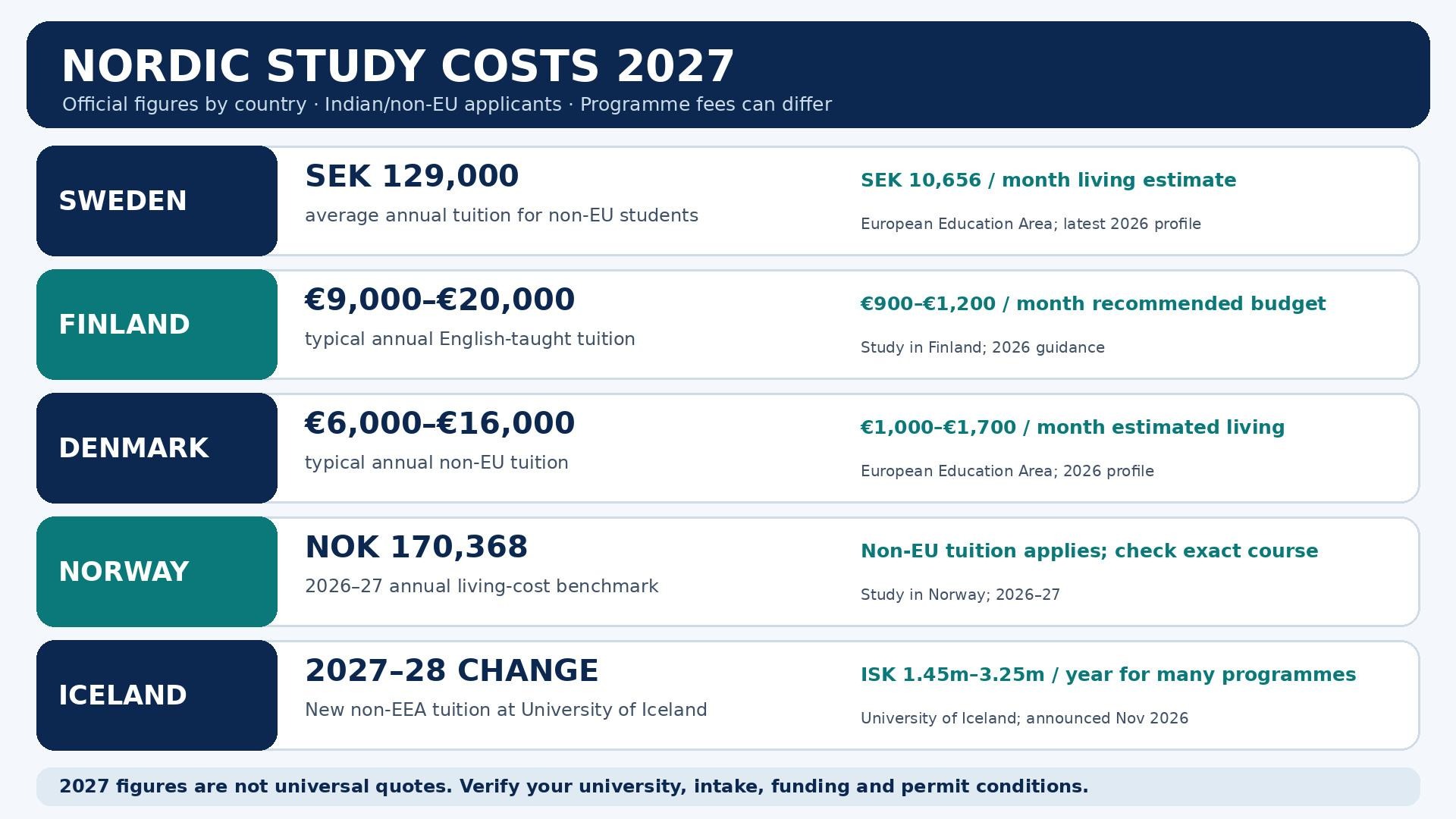
In accordance with the profile of the European Education Area regarding Sweden, the annual tuition fee is SEK 129,000 while studying in Sweden for those who are not citizens of EU countries, and the monthly cost of living is SEK 10,656. Moreover, based on the Finnish profile, the cost of studying in English-language programmes is in the range of €9,000 to €20,000 per year, and the monthly expenses will be from €900 to €1,200. This information should be considered as budgeting numbers.
Denmark gives the following advice: The annual cost of tuition from non-EU countries varies from €6,000 to €16,000 per year, and the monthly cost of living is between €1,000 and €1,700. But Norway does not offer any free tuition to Indians studying in the country. As suggested by the study in Norway, the annual living cost is NOK 170,368 for 2026-2027.
In particular, this country needs to receive an individual warning in regard to this issue. The University of Iceland came out with the fee schedule for foreign students since the year 2027. There are numerous courses where the fee is in between ISK 1.45 million to 3.25 million per year. It is very important that you obtain an offer letter before the ROI calculations.
Scholarships: Can They Reduce the Real Cost?
The higher education institutions in Finland offer institution-based scholarships or tuition waiver programmes. In Sweden, there are university scholarships or competitive scholarships awarded in certain programmes. In Denmark, universities offer partial scholarships for eligible non-EU students; in Norway, funding options are largely programme- and institution-dependent.
The question that arises is how much is this scholarship supposed to cover. Scholarships that cater to the tuition fees alone do not cater to the rent, insurance, cost of food, or transportation charges. It is important for you to focus on some aspects of the scholarship.
Student Work and Post-Study Career Routes
In Finland, higher education students that are eligible can work for an average of 30 hours per week, and graduates that are eligible for a job search permit can have a maximum period of two years. In Sweden, graduates that are eligible can look for employment for a maximum period of one year.
The search for work in Denmark after graduation is dependent on when the applicant applied for the study residence permit and the qualification. In the case of qualifications offered through state-approved bachelor’s and master’s programs, applicants who apply for the programme on or after 1 October 2026 generally have one year to search for work. The previous applications that were equivalent usually took the three-year track. The eligible graduates of Denmark’s PhD programmes normally have the option for three years. Other programmes have six months or no eligibility at all. For the duration of the job search process, the normal number of working hours per month is 90, with full-time employment in June, July, and August; unrestricted employment demands its own permission. See the specific conditions of SIRI for your particular programme and application date.
These opportunities do not promise employment. Local language knowledge, internships, professional networks and industrial demands carry a lot of importance. In the case of international careers, it is advisable for students to find out about their course's relevance to employers before taking admission.
How Should Indian Students Apply for 2027?
Start with making a programme list, qualification verification, and proof of proficiency in the English language. After that, do comparisons based on international tuition fees, scholarship opportunities, length of programme and accommodation possibilities. Finally, prepare your transcripts, passport, financial records and course-related portfolio.
After getting admission to the university, take the checklist for the students’ residence permit from the list given by the immigration department. Find out if your university requires you to furnish your transcripts, IELTS/TOEFL or any other evidence of English language, statement of purpose, references, or any other online portal application form. Application periods differ for each case in the Nordic countries. It is necessary to have an emergency fund since future earnings from part-time work cannot be used as financial proof.
Which Nordic Country Is the Best Fit?
In Finland, one can find a unique feature in that the country provides opportunities for technological education and a definite way to gain employment after graduating. In Sweden, people are interested in innovations and research. Students who have intentions to study a programme related to industrial use can choose Denmark, while for programmes related to energy and environmental sciences with living costs involved, Norway can be an interesting choice. An interesting option for students of geosciences and the the environment can be Iceland, as an interesting alternative.
The Taksheela Institute of Education will assist Indian students in academic profile evaluation, selection of a bachelor's or master's programme, selection of accredited universities, fee and scholarship comparison, and application schedule for respective countries. The counsellors would be well-equipped to help them plan the English exam, SOP, documentation, funding proof, and also visa application. It is within the rights of the students to request a comparative analysis of the five countries as well as the budget estimates.
Looking for an international university in 2027? Why don’t you try booking a counselling session at Taksheela to discuss your profile, admission criteria, scholarships and visa process?
Country-Selection Guide: Which Nordic Destination Fits You?
Take this brief guide to narrow down countries based on your main criteria. These are just starting points and do not guarantee anything.
A Realistic Budget Is More Than Tuition
Prior to deciding anything, calculate the cost of tuition along with the annual rent, food, transport, permit costs, insurance, and air tickets. You should factor in accommodation deposits, winter clothing, and an emergency fund. Looking at only the university costs may mislead you on price. The terms of scholarships also have to be verified: the tuition waiver is not necessarily going to cover your living expenses. Use your prospective college's cost of attendance brochure and housing information, not an average national estimate.
Yet another difference that should be taken into account when discussing mobility is that while Sweden, Finland, and Denmark are all part of the EU, Norway and Iceland are in the European Economic Area but not the EU members. All five participate in the Schengen Agreement, but having a student permit for residence in one of the countries will not necessarily grant employment in another. For an Indian student wishing to have a career in Europe, this is very important.
Final Verdict
The Nordic countries provide a good education and career experience, but it is not a one-size-fits-all package for the same price. The best option for Indian students in 2027 would be to take into account course applicability, sufficient funds, language skills, and a well-thought-out post-graduation plan. Consider these points wisely, and select an appropriate program.
Frequently Asked Questions
There is no one-size-fits-all best choice. Consider the non-EU tuition fees, scholarship opportunities, and monthly cost of living of each program. Neither Norway nor Iceland should be automatically considered tuition free.
Most master’s programmes are available in English, but not all bachelor’s programs are. Proving your knowledge of English could be necessary, and having knowledge of the local language would greatly benefit you when looking for work part-time and as a graduate.
Not necessarily. Eligible applicants of state-recognised bachelor’s and master’s programmes who are applying for a study residence permit from 1 October 2026 onwards have one year to find employment; eligible PhD graduates typically have three years. Always check the latest requirements on SIRI.
Some scholarships may be significant; others may be partial or cover tuition only. Ensure whether the cost of living, insurance, travel, and renewals is covered.
Eligibility criteria may include transcripts, passports, programme-specific eligibility documentation, English test scores where applicable, financial documents, and immigration documents. These will vary from university to university and country to country.
Free MBBS Counselling
Find the Right Country for Your MBBS in 2026
Our MBBS specialists analyse your NEET score, budget and career goals to recommend the right university — at zero cost to you.
Related Articles
Planning your study abroad journey?
Get free expert counselling from Taksheela — trusted by thousands of Indian students for admissions, visas, and test prep.
You May Also Like
More Study Abroad & Education Guides




Study in Malta 2027 for Indian Students: Tuition Fees, Visa and Work Rules
13 Nov 2026 · 10 min
Australia vs New Zealand: Which Destination Gives Students More Value in 2027?
11 Nov 2026 · 12 min
Study Abroad Budget Planning 2027: Tuition Fees, Living Costs and Other Expenses
22 Oct 2026 · 16 min
Study Abroad Education Loans in 2027: Eligibility, Documents and Repayment Options
21 Oct 2026 · 15 min